

Hall of Monuments & Sacred Architecture — Assam
A Curatorial Survey of Tai-Ahom Citadels, UNESCO World Heritage Charaideo Maidams, and Riverine Sanctums
Curatorial Overview & Architectural Significance
The Hall of Monuments in the Assam Wing represents one of the most comprehensive digital documentations of eastern Indian architecture ever assembled. The monuments of Assam offer a fascinating synthesis of indigenous materials, imperial Tai-Ahom engineering, classical Indo-Aryan temple geometry, and riverine monastic woodcraft.
Unlike the arid stone construction of northwestern India, Assamese builders had to contend with the torrential monsoon rains, shifting river channels, and frequent seismic activity of the Brahmaputra valley. In response, Tai-Ahom and medieval Assamese architects developed groundbreaking engineering techniques, utilizing organic mortar formulas—including sticky bora rice, duck eggs, snail lime, and indigenous resin extracts—that have preserved monumental brick and stone citadels intact across half a millennium.
Major Architectural Traditions Documented in the Hall
1. UNESCO World Heritage: Charaideo Royal Maidams
Located at the sacred foothills of the Patkai range near Sivasagar, the Maidams of Charaideo represent the sacred tumuli and funerary architecture of the Tai-Ahom royalty. Revered as the ancestral burial sanctuary founded by Chaolung Sukaphaa in the 13th century, the maidams feature domed brick vaulted chambers covered by monumental earth mounds, reflecting Tai cosmological principles of kingship and spiritual transition. In 2024, Charaideo was officially inscribed as India's 43rd UNESCO World Heritage Site.
2. Imperial Citadels & Amphitheaters of Sivasagar
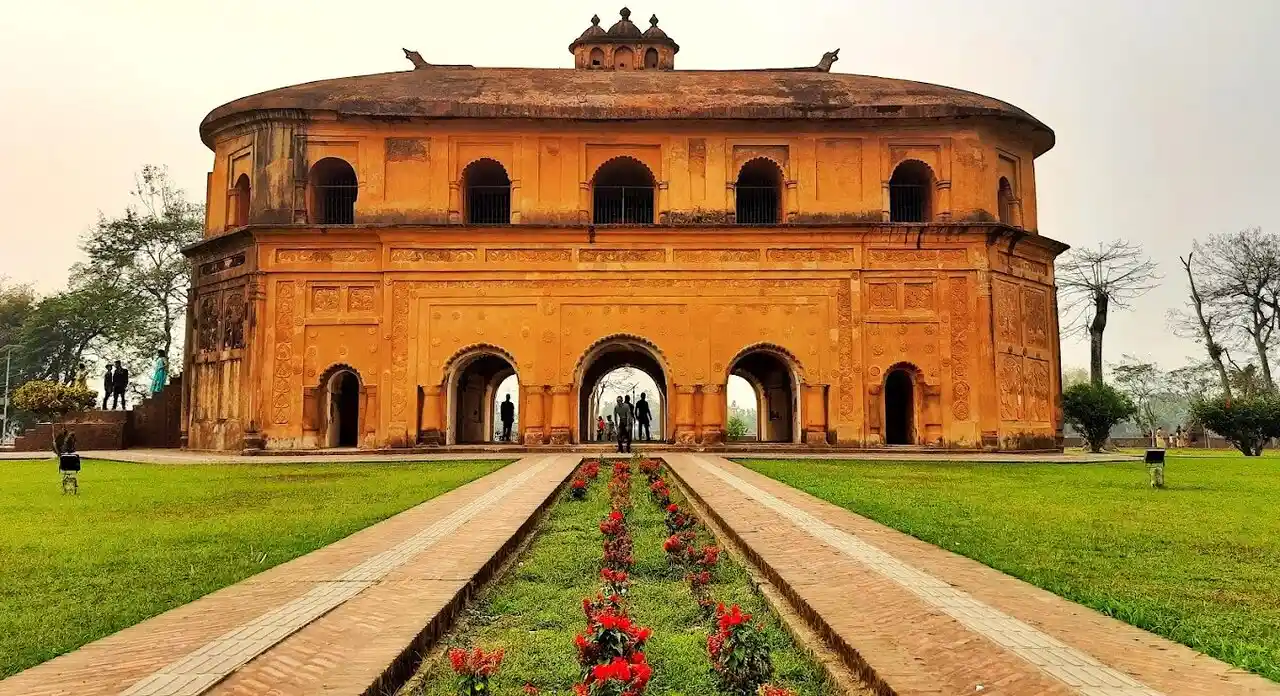
The royal capital of the Ahom dynasty at Sivasagar (Rongpur) preserves monumental secular architecture without parallel in eastern India: the two-story Rang Ghar royal sporting amphitheater built in 1746 CE, and the grand Talatal Ghar and Kareng Ghar brick citadels featuring subterranean secret tunnels, ventilation chambers, and royal audience halls.
3. Classical Kamarupa Rock-Cut Architecture
Classical stone ruins from the 5th to 12th centuries CE testify to the sophistication of ancient Kamarupa. The sculpted Gupta-style doorway of Daparbatia in Tezpur, the rock-cut Ganesha shrines of Kamakhya, and the riverine temple island of Umananda in Guwahati demonstrate exquisite stone carving and astronomical alignment.
4. Riverine Vaishnavite Sattras of Majuli Island
The Vaishnavite monastic campuses of Majuli Island feature majestic Namghars (community prayer sanctums) supported by monumental wooden pillars carved with avatars of Vishnu, intricately painted ceilings, and open-air theatrical grounds.
Indigenous Mortar Metallurgy & Karhal Mortar Science
One of the most remarkable technical achievements of medieval Assamese architecture was the formulation of Karhal mortar—a resilient bio-composite adhesive used in place of modern Portland cement. To bind massive kiln-fired flat bricks together into monolithic palaces like the Talatal Ghar and Rang Ghar, Tai-Ahom master masons prepared an elaborate organic recipe:
- Sticky Bora Rice: The indigenous glutinous rice of Assam, rich in amylopectin starches, provided high tensile adhesion and flexibility under seismic shaking.
- Duck Eggs (Hahor Koni): Albumin and yolk proteins created natural water-repellent polymers that prevented moisture seepage during monsoon downpours.
- Snail Lime (Xamuk Choon): Calcined freshwater river snail shells provided calcium carbonate and calcium hydroxide for structural bonding.
- Black Gram (Mati Mah) & Molasses (Gur): Organic sugars and vegetable proteins slowed down curing times, allowing the masonry to settle without shrinkage cracks.
- Resin Extracts (Dhoon): Tree gums from Shorea robusta (sal) and Canarium resiniferum formed impervious crystalline barriers against dampness.
Scientific analysis by architectural conservators confirms that Karhal mortar undergoes continuous micro-carbonation over centuries, rendering medieval Ahom citadels increasingly hard and weather-resistant over time.
The Ten Verified Monument Collections Directory
Explore all ten curated permanent collections within the Assam Hall of Monuments:
- Ahom Royal Architecture — Imperial palaces, pavilions, and citadels of Rongpur and Garhgaon.
- Ancient Stone Dynasties — Classical Kamarupa basalt temple lintels and rock-cut carvings.
- Charaideo Royal Maidams — The UNESCO World Heritage burial tumuli of Tai-Ahom emperors.
- Frontier Fortresses & Southern Kingdoms — Defensive hill ramparts and medieval Kachari ruins.
- Historic Ramparts & Hydraulic Dykes — Dhodar Ali, Lachit Garh, and Tai-Ahom hydraulic dykes.
- Island Shrines & Sacred Astronomy — The Peacock Island of Umananda and astronomical sanctums.
- Medieval Stone Carvings & Sculptures — Classical Kamarupa basalt temple lintels, rock-cut carvings, and monolithic shrines.
- Riverine Monasteries & Sanctuaries — Majuli's living timber prayer sanctums and sattra quadrangles.
- Sacred Temples & Monumental Tanks — Joysagar and Sivasagar monumental hydraulic engineering.
- Sacred Thans & Vaishnavite Sanctuaries — Forest shrines and monastic sanctuaries across Assam.